AI in oncology
Machine learning and large language models for clinical decision support, efficacy and toxicity prediction, and structured data extraction at scale.
Dr. Osterman's AI work in oncology is grounded in clinical practice. He treats patients, sees what data is actually available, and builds models around that constraint rather than around what would be ideal in a research setting. The work breaks into four threads: a multi-year pre-LLM bet on real-world immunotherapy prediction, an early structured evaluation of clinical large language models, a recent invited framework piece for the field, and ongoing national thought leadership at the policy table.
The first thread is the five-year GE HealthCare Digital Precision Oncology collaboration (2019-2024), which predated the current AI mainstream and was built against two prevailing assumptions in the immune checkpoint inhibitor literature. Most prior ICI-prediction work used carefully curated cohorts; the DPO work used routinely collected EHR data so resulting models could be deployed without first reorganizing the underlying data pipeline. Most prior work focused on a single cancer type; the DPO work was deliberately pan-cancer, accepting the sample-size challenge in exchange for models that generalized. The program produced three peer-reviewed manuscripts, multiple abstracts, twelve conference presentations, and a U.S. patent (Wolber, Csernai, Kiss, Lippenszky, Horváth, Osterman et al.). Dr. Osterman led teams across the U.S., Hungary, and Germany, and presented the work internationally, including the ESMO Immuno-Oncology Annual Congress in Geneva. The full arc is covered in the Digital Precision Oncology case study.
The second thread began in early 2023 when ChatGPT entered the clinic. Dr. Osterman saw the need for an actual evaluation rather than the speculative discourse that dominated the conversation. He designed a multidisciplinary prospective trial structure for evaluating LLM responses to physician-authored questions and supervised Dr. Rachel Goodman (then a medical student) and Dr. Douglas Johnson in executing it. The result, Accuracy and Reliability of Chatbot Responses to Physician Questions (Goodman et al., JAMA Network Open, 2023), was one of the earliest peer-reviewed clinical LLM evaluations and has been widely cited in the policy debates that followed.
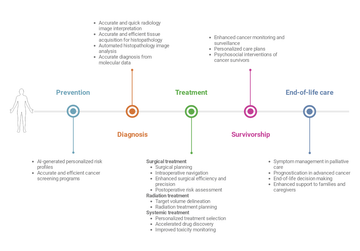
In August 2025, Cancer invited Dr. Osterman and colleagues to write Artificial intelligence across the cancer care continuum (Riaz, Khan & Osterman, 2025) - a framework piece mapping AI applications across screening, diagnosis, treatment selection, toxicity prediction, survivorship, and quality of life. The framing is intentional: AI is not one thing in oncology; it is many overlapping technologies at different stages of validation. The review now functions as one of the reference frames the field uses to scope its own work.
 The work has reach well beyond academic medicine. Dr. Osterman
delivered the keynote at the 2025 NCCN AI policy meeting
(AI and the Cancer Journey: Navigating New Frontiers in Policy
and Technology, September 2025) and was the AI keynote speaker at
the 2026 NCCN Annual Conference (Harnessing Artificial Intelligence
to Improve Oncology Care, March 2026). NCCN's audience extends
beyond physicians to oncology nursing, industry leadership, regulators,
and payers - the constituencies that have to act on AI-in-oncology
conclusions, not just produce them.
The work has reach well beyond academic medicine. Dr. Osterman
delivered the keynote at the 2025 NCCN AI policy meeting
(AI and the Cancer Journey: Navigating New Frontiers in Policy
and Technology, September 2025) and was the AI keynote speaker at
the 2026 NCCN Annual Conference (Harnessing Artificial Intelligence
to Improve Oncology Care, March 2026). NCCN's audience extends
beyond physicians to oncology nursing, industry leadership, regulators,
and payers - the constituencies that have to act on AI-in-oncology
conclusions, not just produce them.
The through-line across these four threads is structure. ICI prediction works because the EHR data underneath is curated and consistent. LLM evaluation matters because that's where unstructured text becomes downstream clinical action. The Cancer review and the NCCN keynotes argue the same point at policy scale: AI's clinical value scales with the quality of the data and standards underneath it. See also cancer data standards (mCODE) and clinical genomics in the EHR for the foundation that makes this work tractable.
Named programs
- GE HealthCare Digital Precision Oncology
- mCODEGPT zero-shot extraction (Communications Medicine, 2025)
- ChatGPT clinical Q&A evaluation (JAMA Network Open, 2023)
- Cancer care continuum review (Cancer, 2025)
Case study
This domain has a long-form case study: AI in oncology.
Peer-reviewed publications (12)
- Michael J. Robinson et al. The CAUSAL study: a prospective cohort of sarcoma survivors across the lifespan. BMC Cancer Aug 27, 2026
- . Harnessing Artificial Intelligence to Improve Oncology Care. Journal of the National Comprehensive Cancer Network May 20, 2026
- Kai Zhang, Tongtong Huang, Bradley A. Malin, Travis Osterman, Qi Long, Xiaoqian Jiang. Introducing mCODEGPT as a zero-shot information extraction from clinical free text data tool for cancer research. Communications Medicine Oct 15, 2025
- Irbaz Bin Riaz, Muhammad Ali Khan, Travis J. Osterman. Artificial intelligence across the cancer care continuum. Cancer Aug 15, 2025
- David S. Smith et al. Radiomics and Deep Learning Prediction of Immunotherapy-Induced Pneumonitis From Computed Tomography. JCO Clinical Cancer Informatics Feb 20, 2025
- Levente Lippenszky et al. Prediction of Effectiveness and Toxicities of Immune Checkpoint Inhibitors Using Real-World Patient Data. JCO Clinical Cancer Informatics Mar 21, 2024
- Rachel S. Goodman et al. Accuracy and Reliability of Chatbot Responses to Physician Questions. JAMA Network Open Oct 2, 2023
- Protiva Rahman et al. Accelerated curation of checkpoint inhibitor-induced colitis cases from electronic health records. JAMIA Open Apr 1, 2023
- Rachel S. Goodman, J. Randall Patrinely, Travis Osterman, Lee Wheless, Douglas B. Johnson. On the cusp: Considering the impact of artificial intelligence language models in healthcare. Med (New York, N.Y.) Mar 10, 2023
- Douglas Johnson et al. Assessing the Accuracy and Reliability of AI-Generated Medical Responses: An Evaluation of the Chat-GPT Model (under review). Feb 28, 2023
- Kim L Sandler et al. Women screened for breast cancer are dying from lung cancer: An opportunity to improve lung cancer screening in a mammography population. Journal of Medical Screening May 4, 2021
- Neha M. Jain, Alison Culley, Christine M. Micheel, Travis J. Osterman, Mia A. Levy. Learnings From Precision Clinical Trial Matching for Oncology Patients Who Received NGS Testing. JCO Clinical Cancer Informatics Feb 1, 2021
Selected talks (12)
- Vanderbilt Lecture Series CME (Nashville, Tennessee): "Using AI in Clinical Practice: Current Trends and Emerging Federal Regulations". May 7, 2026
- 2026 NCCN Annual Conference (Orlando, Florida): "Harnessing Artificial Intelligence to Improve Oncology Care". Mar 28, 2026
- NASEM Workshop: Policy Issues for Integrating Artificial Intelligence in Cancer Research and Care (Washington, DC): "AI in Cancer Care: 2 Wins, 2 Current Challenges". Mar 9, 2026
- Jackson-Madison County General Hospital (Jackson, Tennessee): "An Update on the Use of AI in Clinical Practice". Mar 6, 2026
- Blanchfield Army Community Hospital (Fort Campbell, Kentucky (virtual)): "Using AI in Clinical Practice: Current Trends and Emerging Federal Regulations". Feb 10, 2026
- NCCN EHR Advisory Board (Virtual): "Clinical Trial Enrollment A Pragmatic Approach". Nov 8, 2024
- University of Hawaii, Artificial Intelligence, Precision Health Institute (Virtual): "Predictive AI Models - Data Standards in Action". May 10, 2024
- The Evolving Artificial Intelligence Landscape in Cancer Care: "AI and the Cancer Journey: Navigating New Frontiers in Policy and Technology". Sep 9, 2025
- NICT (Durhman, NC): "Prediction of Effectiveness and Toxicities of Immune Checkpoint Inhibitors Using Real-World Patient Data". Mar 1, 2025
- ESMO Immuno-Oncology Annual Congress (Geneva, Switzerland): "Prediction of immune checkpoint inhibitor outcome and side effects by use of machine learning and routine real-world data". Dec 11, 2024
- Society for Immunotherapy of Cancer Annual Meeting (San Diego, CA): "EHR-based Models for Predicting Efficacy and Toxicities Prior to ICI Treatment". Nov 4, 2023
- IO360 (Brooklyn, NY): "Predicting Efficacy and Toxicities Prior to Immune Checkpoint Inhibitor Treatment". Feb 9, 2023
Abstracts (8)
- Pablo Napan Molina et al. 1228 Machine learning models can predict efficacy and toxicities using short medical history prior to ICI therapy | Journal for ImmunoTherapy of Cancer. Nov 5, 2024
- David Smith et al. 1246 Prediction of pneumonitis in immunotherapy patients from prior thorax CT. Journal for ImmunoTherapy of Cancer Nov 1, 2024
- Pablo Napan Molina et al. 1228 Machine learning models can predict efficacy and toxicities using short medical history prior to ICI therapy. Journal for ImmunoTherapy of Cancer Nov 1, 2024
- Zoltan Kiss et al. 1294 External validation of machine learning models to predict efficacy and toxicity of immune checkpoint inhibitors using real-world pan cancer cohorts. Journal for ImmunoTherapy of Cancer Nov 1, 2023
- Levente Lippenszky et al. 1300 Prediction of efficacy and toxicities of immune checkpoint inhibitors using real-world patient data. Journal for ImmunoTherapy of Cancer Nov 1, 2023
- Eszter Csernai et al. Rolling window-based hepatitis toxicity prediction from routine bloodwork in patients undergoing immune checkpoint inhibitor therapy.. Journal of Clinical Oncology Jun 2022
- Gergely Horváth et al. Predicting immune checkpoint inhibitor-related hepatitis using electronic health records of patients.. Journal of Clinical Oncology Jun 2022
- Levente Lippenszky et al. Predicting immune checkpoint inhibitor-related pneumonitis using patient medical information.. Journal of Clinical Oncology Jun 2022
In the news (7)
- AI could predict whether cancer treatments will work, experts say | Fox News . Apr 23, 2024
- GE Healthcare, Vanderbilt Explore Use of AI to Predict Immunotherapy Toxicity, Efficacy · Precision Medicine Online. Nov 27, 2023
- The immunotherapy hurdle – and why doctors could soon predict how each patient will respond . Apr 9, 2019
- GE and VUMC partner to make cancer immunotherapy safer and more precise · dotmed.com. Jan 8, 2019
- Navigating AI Use for Improving Oncology Care—Challenges, Regulation, and Opportunities · ASCO AI in Oncology.
- Machine Learning Model Could Help Predict Risk-Benefit of Immune Checkpoint Inhibitors · ASCO Daily News.
- Podcast: New Machine Learning Framework Uses EHR Data to Assess ICI Effectiveness, Toxicity · ASCO Daily News.
Related: all expertise domains · Cancer data standards · Clinical genomics in the EHR · Precision oncology · CI education · Lung cancer.
Frequently asked questions
- What is Dr. Osterman's approach to AI in oncology?
- Dr. Osterman's AI work in oncology is grounded in clinical practice. He treats patients, observes what data is actually available, and builds models around that constraint rather than around idealized research conditions. His work spans real-world immunotherapy outcome prediction, early evaluation of clinical large language models, an invited framework piece for the field, and national thought leadership.
- What was the GE HealthCare Digital Precision Oncology collaboration?
- It was a five-year collaboration from 2019 to 2024 that used routinely collected EHR data to predict immune checkpoint inhibitor efficacy and toxicity. It was deliberately pan-cancer rather than focused on a single cancer type. The program produced three peer-reviewed manuscripts, multiple abstracts, twelve conference presentations, and a U.S. patent, with teams across the United States, Hungary, and Germany.
- What did Dr. Osterman's early ChatGPT evaluation study find?
- Dr. Osterman designed a multidisciplinary prospective trial structure for evaluating large language model responses to physician-authored questions and supervised its execution. The result, Accuracy and Reliability of Chatbot Responses to Physician Questions (Goodman et al., JAMA Network Open, 2023), was one of the earliest peer-reviewed clinical LLM evaluations and has been widely cited in subsequent policy debates.
- Has Dr. Osterman spoken on AI policy in oncology?
- Yes. He delivered the keynote at the 2025 NCCN AI policy meeting and was the AI keynote speaker at the 2026 NCCN Annual Conference. He also co-authored Artificial intelligence across the cancer care continuum (Riaz, Khan and Osterman, Cancer, 2025), an invited framework piece mapping AI applications across screening, diagnosis, treatment selection, toxicity prediction, survivorship, and quality of life.