Digital Precision Oncology with GE HealthCare
A five-year strategic research collaboration on predicting immune checkpoint inhibitor effectiveness and toxicities from real-world electronic-health-record data. Travis Osterman served as principal investigator on the flagship study; the program produced three peer-reviewed manuscripts, multiple abstracts, and a patent.
The clinical problem
Immune checkpoint inhibitors (ICIs) have transformed cancer care. They allow subgroups of patients with previously incurable disease to have longer, higher-quality lives. They also carry the risk of severe immune-related adverse events: hepatitis, colitis, and pneumonitis, some of which are life-threatening and any of which forces discontinuation of an otherwise-working therapy. Oncologists make the treatment decision without a clean way to predict who will respond and who will be harmed. A personalized risk-benefit profile - generated before the first dose - would improve safety, extend treatment duration for responders, and improve clinical trial cohort selection.
The partnership
In 2019 Vanderbilt and GE HealthCare announced a five-year strategic research collaboration centered on this problem (dotmed.com, January 2019). The Digital Precision Oncology study was the flagship: Dr. Osterman as principal investigator from Vanderbilt; Jan Wolber leading on the GE HealthCare side; multi-disciplinary teams on both sides spanning medical oncology, radiochemistry, biostatistics, bioinformatics, and machine learning. The collaboration ran through 2024.
The approach
The team built a machine-learning framework using real-world clinical data already living in the Vanderbilt electronic health record: baseline labs, comorbidities, prior treatments, demographics, and imaging. The cohort grew over the course of the program; the JCO CCI 2024 flagship paper drew on more than 2,200 patients treated with ICIs. Models predicted both efficacy (one-year overall survival) and three major immunotoxicities (hepatitis, colitis, pneumonitis) using only pre-treatment data, generating per-patient risk-benefit profiles. The technical framing was deliberately conservative: short medical-history windows, careful validation, clinically interpretable features over black-box embeddings.
The published results
The flagship paper, Prediction of Effectiveness and Toxicities of Immune Checkpoint Inhibitors Using Real-World Patient Data (Lippenszky et al., JCO Clinical Cancer Informatics, 2024), demonstrated that routinely-collected EHR data is enough to build clinically useful prediction models - across both efficacy and toxicity, without bespoke biomarker panels or unstructured-data extraction pipelines.
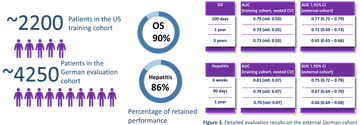
An imaging companion paper followed in 2025. Radiomics and Deep Learning Prediction of Immunotherapy-Induced Pneumonitis From Computed Tomography (Smith et al., JCO CCI, 2025) extended the framework to imaging: 2,700 pre-treatment thorax CT volumes for hundreds of patients, with radiomic features and deep-learning models predicting which patients would later develop ICI-induced pneumonitis. External validation across multi-center pan-cancer cohorts was reported at SITC in 2023 (Kiss, Lippenszky et al., abstract 1294).
The patent Model generation apparatus for therapeutic prediction and associated methods and models (Wolber, Csernai, Kiss, Lippenszky, Horváth, Osterman, Park, Smith, Fabbri, LeNoue-Newton, Mittendorf) captures the underlying framework.
Total output
- 4 peer-reviewed manuscripts
- 8 published abstracts
- 12 conference presentations across ASCO, SITC, and ASCO GI
- 1 patent on the model-generation framework
Beyond the published record, the work was covered by ASCO Daily News in two pieces and a podcast, and by Precision Medicine Online in November 2023.
What comes next
The collaboration ended in 2024 as planned, but the line of research continues. Models for ICI-induced hepatitis and colitis are in active development. The clinical insight - that routinely collected EHR data carries enough signal to generate a meaningful risk-benefit profile before the first dose - is now part of a broader research program at Vanderbilt-Ingram on bringing predictive analytics into routine oncology decision-making.
The lesson
The Digital Precision Oncology program is what happens when a careful clinical question gets paired with real-world EHR data, conservative machine-learning methodology, and multi-year institutional commitment. No one paper changed practice. The cumulative work made it credible that pre-treatment risk-benefit prediction for immunotherapy is achievable from the data that already exists in every cancer center's EHR. That credibility is what's required before any of this lands at the bedside.
Cited works
- Lippenszky L, Mittendorf KF, Kiss Z, LeNoue-Newton ML, Napan-Molina P, Rahman P, Ye C, Laczi B, Csernai E, Jain NM, Holt ME, Maxwell CN, Ball M, Ma Y, Mitchell MB, Johnson DB, Smith DS, Park BH, Micheel CM, Fabbri D, Wolber J, Osterman TJ. Prediction of Effectiveness and Toxicities of Immune Checkpoint Inhibitors Using Real-World Patient Data. JCO Clinical Cancer Informatics 2024.
- Smith DS, Lippenszky L, LeNoue-Newton ML, Jain NM, Mittendorf KF, Micheel CM, Cella PA, Wolber J, Osterman TJ. Radiomics and Deep Learning Prediction of Immunotherapy-Induced Pneumonitis From Computed Tomography. JCO Clinical Cancer Informatics 2025.
- Kiss Z, Lippenszky L, Laczi B, Napan-Molina P, Csernai E, Brehmer A, Kim M, Keyl J, Siveke J, Meyer M, Grünwald V, Kasper S, Roesch A, Schuler M, Osterman T, Wolber J, Kleesiek J. External validation of machine learning models to predict efficacy and toxicity of immune checkpoint inhibitors using real-world pan cancer cohorts. SITC 2023, abstract 1294.
- Wolber J, Csernai EK, Kiss Z, Lippenszky L, Horváth G, Osterman T, Park BH, Smith DS, Fabbri D, LeNoue-Newton ML, Mittendorf K. Model generation apparatus for therapeutic prediction and associated methods and models. Patent.
Related: GE HealthCare collaboration entry · AI in oncology - efficacy and toxicity prediction · AI in oncology (case study).
Frequently asked questions
- What was the GE HealthCare Digital Precision Oncology collaboration?
- It was a five-year strategic research collaboration between Vanderbilt and GE HealthCare, announced in 2019 and running through 2024, focused on predicting immune checkpoint inhibitor effectiveness and toxicities from real-world electronic-health-record data. Dr. Osterman served as principal investigator on the flagship Digital Precision Oncology study, with Jan Wolber leading on the GE HealthCare side.
- What did the Digital Precision Oncology study predict?
- The machine-learning framework predicted both efficacy, measured as one-year overall survival, and three major immune-related toxicities, hepatitis, colitis, and pneumonitis, using only pre-treatment data. It generated per-patient risk-benefit profiles from routinely collected clinical data such as baseline labs, comorbidities, prior treatments, demographics, and imaging.
- What were the published results of the collaboration?
- The flagship paper by Lippenszky and colleagues appeared in JCO Clinical Cancer Informatics in 2024 and showed that routinely collected EHR data is enough to build clinically useful prediction models across both efficacy and toxicity. A 2025 imaging companion paper extended the framework to thorax CT volumes to predict immunotherapy-induced pneumonitis, and external validation across multi-center pan-cancer cohorts was reported at SITC in 2023.
- How much research output did the program produce?
- The program produced three peer-reviewed manuscripts, eight published abstracts, twelve conference presentations across ASCO, SITC, and ASCO GI, and one patent on the model-generation framework. The flagship JCO CCI 2024 paper drew on more than 2,200 patients treated with immune checkpoint inhibitors.
- What happened after the collaboration ended in 2024?
- The collaboration ended in 2024 as planned, but the line of research continues. Models for immune-checkpoint-inhibitor-induced hepatitis and colitis are in active development, and the clinical insight is now part of a broader research program at Vanderbilt-Ingram on bringing predictive analytics into routine oncology decision-making.